Did you mean:
Watchword17 Results for : watchwords
-

On the Shortness of Life, On the Happy Life, and Other Essays: Essays, Volume 1 , Hörbuch, Digital, ungekürzt, 367min
As former tutor and adviser to Emperor Nero, philosopher and statesman Seneca was acutely aware of how short life can be - his own life was cut short when the emperor ordered him to commit suicide (for alleged involvement in a conspiracy). And Seneca proved true to his words - his lifelong avowal to Stoicism enabled him to conduct himself with dignity to the end. During his rich and busy life, Seneca wrote a series of essays that have advised and enriched the lives of generations down to the present day. This collection contains five of the key essays - 'On the Shortness of Life', 'On the Happy Life', 'On the Tranquil Mind', 'On Providence' and 'On the Firmness of the Wise Person' - and they are replete with observations to remember. 'Those who forget the past, neglect the present, and fear for the future have a life that is very brief and troubled,' Seneca warns. 'You have all the fears of mortals and all the desires of immortals.' 'As long as we wander at random, not following any guide except the shouts and discordant clamours of those who invite us to proceed in different directions, our short life will be wasted in useless roamings.' Clarity, steadfastness and true enjoyment are his watchwords. ungekürzt. Language: English. Narrator: James Cameron Stewart. Audio sample: https://samples.audible.de/bk/dhrm/000027/bk_dhrm_000027_sample.mp3. Digital audiobook in aax.- Shop: Audible
- Price: 9.95 EUR excl. shipping
-

Cypherpunks: Freedom and the Future of the Internet , Hörbuch, Digital, ungekürzt, 253min
Cypherpunks are activists who advocate the widespread use of strong cryptography (writing in code) as a route to progressive change. Julian Assange, the editor-in-chief of and visionary behind WikiLeaks, has been a leading voice in the cypherpunk movement since its inception in the 1980s. Now, Assange brings together a small group of cutting-edge thinkers and activists from the front line of the battle for cyber-space to discuss whether electronic communications will emancipate or enslave us. Among the topics addressed are: Do Facebook and Google constitute "the greatest surveillance machine that ever existed", perpetually tracking our location, our contacts and our lives? Far from being victims of that surveillance, are most of us willing collaborators? Are there legitimate forms of surveillance, for instance in relation to the "Four Horsemen of the Infopocalypse" (money laundering, drugs, terrorism, and pornography)? And do we have the ability, through conscious action and technological savvy, to resist this tide and secure a world where freedom is something which the Internet helps bring about? The harassment of WikiLeaks and other Internet activists, together with attempts to introduce anti-file sharing legislation such as SOPA and ACTA, indicate that the politics of the Internet have reached a crossroads. In one direction lies a future that guarantees, in the watchwords of the cypherpunks, "privacy for the weak and transparency for the powerful"; in the other lies an Internet that allows government and large corporations to discover ever more about internet users while hiding their own activities. Assange and his co-discussants unpick the complex issues surrounding this crucial choice with clarity and engaging enthusiasm. ungekürzt. Language: English. Narrator: Tom Pile. Audio sample: https://samples.audible.de/bk/adbl/012015/bk_adbl_012015_sample.mp3. Digital audiobook in aax.- Shop: Audible
- Price: 9.95 EUR excl. shipping
-

Transformative Visions for Qualitative Inquiry (eBook, PDF)
Transformative Visions for Qualitative Inquiry takes as its central theme the idea of transformation, transformative action, transformative possibilities, and potentialities for the future for qualitative inquiry. In a present moment defined by a pandemic of meanings over COVID-19, climate change, political upheaval, inequality, and oppression of all kinds, contributors to this volume seek a new way forward-to reimagine a post-pandemic pedagogy of hope and compassion both for qualitative research and for the communities in which we inhabit. Empathy. Healing. Collaboration. Survival. Discomfort. Protection. Justice. Creative agency. The arts. These are the watchwords for the road ahead. In these uncertain times, leading international scholars from the United States, Canada, and Australia look ahead with a renewed sense of hope, but remain grounded in the reality that much work lies ahead-that our inquiry must meet the demands of our hopeful but evolving future. More specifically, contributors focus on such topics as: academic healing; environmental justice; the hegemony of higher education and challenges to critical education; arts-based research such as songwriting, participatory workshops, and autopoetics; disruptions to conventional humanist and Western modes of thought; and questions of empathy and spirit-writing. Transformative Visions for Qualitative Inquiry is a must-read for faculty and students alike who are interested in imagining new ways to restore healing from the pandemic-to push back, resist, heal, share, laugh, and live.- Shop: buecher
- Price: 32.95 EUR excl. shipping
-

Transformative Visions for Qualitative Inquiry (eBook, ePUB)
Transformative Visions for Qualitative Inquiry takes as its central theme the idea of transformation, transformative action, transformative possibilities, and potentialities for the future for qualitative inquiry. In a present moment defined by a pandemic of meanings over COVID-19, climate change, political upheaval, inequality, and oppression of all kinds, contributors to this volume seek a new way forward-to reimagine a post-pandemic pedagogy of hope and compassion both for qualitative research and for the communities in which we inhabit. Empathy. Healing. Collaboration. Survival. Discomfort. Protection. Justice. Creative agency. The arts. These are the watchwords for the road ahead. In these uncertain times, leading international scholars from the United States, Canada, and Australia look ahead with a renewed sense of hope, but remain grounded in the reality that much work lies ahead-that our inquiry must meet the demands of our hopeful but evolving future. More specifically, contributors focus on such topics as: academic healing; environmental justice; the hegemony of higher education and challenges to critical education; arts-based research such as songwriting, participatory workshops, and autopoetics; disruptions to conventional humanist and Western modes of thought; and questions of empathy and spirit-writing. Transformative Visions for Qualitative Inquiry is a must-read for faculty and students alike who are interested in imagining new ways to restore healing from the pandemic-to push back, resist, heal, share, laugh, and live.- Shop: buecher
- Price: 32.95 EUR excl. shipping
-

Epicurus of Samos: His Philosophy and Life: All the Principal Source Texts , Hörbuch, Digital, ungekürzt, 380min
Epicurus of Samos (341-270 BCE) was the founder of the philosophical system to which he gave his name: Epicureanism. It is a label that is often misused and misunderstood today, with ‘a life of pleasure’ as the key aim misinterpreted as a life of indulgence. In fact, the philosophy of Epicurus demonstrated also by his life, was anything but! He established a school in Athens called The Garden, underpinned by his system of ethics.He promoted, by his own example, a simple, ordered, calm and reflective life.A life of true pleasure, he proposed, is only possible when unharnessed desire for wealth, position, luxury and power has been dissolved and instead steady living and friendship are the watchwords. It is against this background that the understanding and acceptance of the vicissitudes of life, and the inevitability of death, are the rules by which to live. This was in contrast to Platonism on the one hand and the Cynics on the other. The second major facet of Epicurus’ philosophy was his physics, in which he adopted and furthered the theory of atomism introduced by Democritus (460-370 BCE): there was no ‘first mover’, no creation myth, no afterlife. Atoms underpinned all existence. Epicurus was a prodigious author, producing many books - yet very few survive. Diogenes Laertius, the third-century Greek biographer, in his sizeable Lives of Eminent Philosophers, devotes Book X, the final book, to Epicurus. In it he gives an account of the life of the philosopher and including three letters from Epicurus to friends, to Herodotus, Pythocles and Menoeceus. The biography concludes with the concise The Principal Doctrines of Epicurus. Then there are various fragments which have come down to us: The Vatican Sayings (a collection found in the Vatican Library, originally compiled in the 14th century and rediscovered in the 19th century); Epicurean Fragments collected in the 19th century from many classical autho ungekürzt. Language: English. Narrator: James Gillies, Jonathan Booth. Audio sample: https://samples.audible.de/bk/dhrm/000270/bk_dhrm_000270_sample.mp3. Digital audiobook in aax.- Shop: Audible
- Price: 9.95 EUR excl. shipping
-
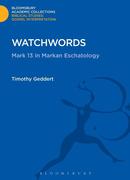
Watchwords
Watchwords - Mark 13 in Markan Eschatology: ab 136.99 €- Shop: ebook.de
- Price: 136.99 EUR excl. shipping
-

Watchwords
Watchwords - Romanticism and the Poetics of Attention: ab 60.49 €- Shop: ebook.de
- Price: 60.49 EUR excl. shipping